
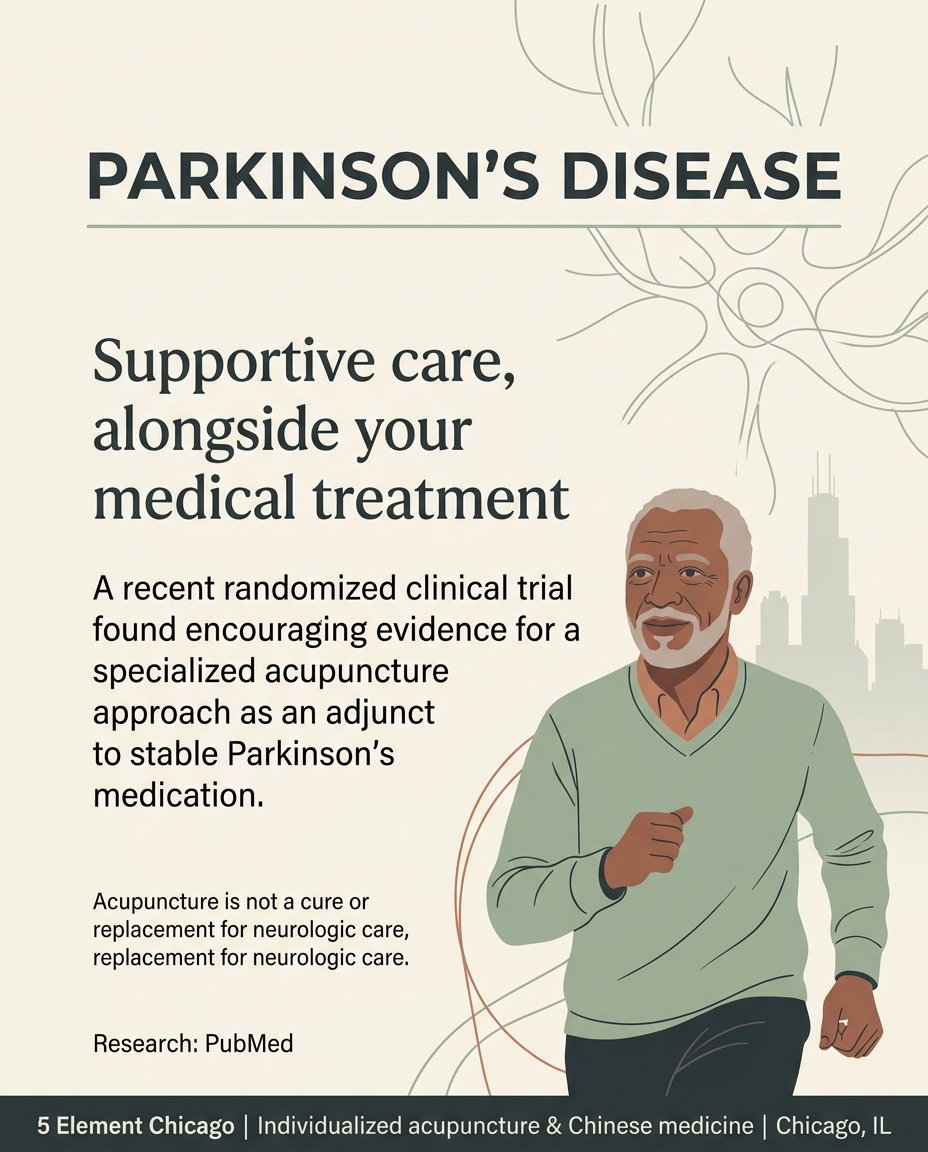
Acupuncture and Parkinson’s Disease: What New Research Shows
Parkinson’s disease is a progressive neurological condition that can affect movement, balance, energy, sleep, mood, and day-to-day quality of life. While medication remains central to Parkinson’s care, many people continue to experience symptoms that are not fully addressed by medication alone. A recent randomized clinical trial offers encouraging evidence that a specialized acupuncture approach may be a helpful addition to a patient’s existing medical treatment plan.
At 5 Element Chicago, I view acupuncture as supportive, individualized care—not a replacement for a neurologist, prescribed medication, physical therapy, or other essential treatment. For people living with Parkinson’s disease, the goal is to support the whole person and help improve comfort, function, resilience, and quality of life.
Why Parkinson’s Symptoms Can Be So Challenging
Parkinson’s disease is often associated with motor symptoms such as slowness of movement, stiffness, tremor, changes in walking, and impaired balance. These symptoms can make everyday activities feel more difficult, from getting out of a chair to walking confidently through the city or keeping up with family and friends.
However, Parkinson’s can involve much more than movement. Many people also experience fatigue, disrupted sleep, changes in mood, discomfort, digestive concerns, stress, and a reduced sense of well-being. Because each person’s experience can be different, supportive care needs to be tailored rather than one-size-fits-all.
A New Randomized Trial of Acupuncture for Parkinson’s
A 2026 randomized, single-blind, sham-controlled clinical trial examined Qihuang needle therapy, a specialized acupuncture technique, for people with idiopathic Parkinson’s disease. The study included 140 participants who continued taking their stable Parkinson’s medications while being randomly assigned to receive either the acupuncture treatment or sham acupuncture.
Participants received nine treatment sessions over six weeks. Researchers used the Unified Parkinson’s Disease Rating Scale Part III, commonly called UPDRS-III, as the primary measure of change in motor symptoms. This scale is widely used to evaluate movement-related challenges in Parkinson’s disease.
What makes this study particularly meaningful is its use of sham acupuncture as a comparison. Rather than comparing acupuncture with no treatment, the researchers compared it with a carefully designed placebo-style intervention. This helps researchers better evaluate whether the specific acupuncture treatment itself contributed to the results.
What the Researchers Found
At the six-week point, participants receiving Qihuang needle therapy had greater improvement in motor symptoms than those receiving sham acupuncture. The difference between groups on the UPDRS-III was 8.45 points in favor of acupuncture.
The results were still present four weeks after treatment had ended. At the 10-week follow-up, the difference between groups was 10.88 points in favor of the acupuncture group. The acupuncture group also experienced statistically significant improvements in non-motor symptoms and Parkinson’s-related quality of life.
The researchers noted especially strong results among participants with postural instability and gait difficulties. These are important symptoms because they can affect confidence, independence, mobility, and fall risk. You can read the full research abstract on PubMed.
What These Results Do—and Do Not—Mean
This study provides encouraging clinical evidence that acupuncture may be a useful adjunctive treatment for some people with Parkinson’s disease. It does not mean that acupuncture cures Parkinson’s disease or replaces conventional medical care. Parkinson’s is a complex neurological condition, and every treatment decision should be made in collaboration with a patient’s medical team.
Still, this research adds to an important conversation: many people with Parkinson’s need additional support beyond medication management alone. When provided by a qualified practitioner and coordinated appropriately with medical care, acupuncture may be one way to address symptoms that continue to affect daily life.
How Five-Element Acupuncture Approaches Care
At 5 Element Chicago, I do not approach Parkinson’s disease as a checklist of symptoms. I begin by listening carefully to the person in front of me: what has changed, what feels most difficult, what supports are already in place, and where they hope to feel more like themselves again.
Five-element acupuncture is deeply individualized. Two people with the same diagnosis may have very different experiences of stiffness, sleep disruption, anxiety, fatigue, digestion, pain, or imbalance. Treatment is designed around the whole system, with attention to both immediate concerns and the broader patterns affecting health and vitality.
For some patients, care may focus on helping the body manage tension, discomfort, stress, sleep disruption, or the sense of depletion that can come with living with a chronic condition. When clinically appropriate, I may also use supportive modalities such as cupping, gua sha, or craniosacral therapy. The approach is always personalized and paced to the individual.
Acupuncture as Part of an Integrative Care Plan
The strongest approach to Parkinson’s care is often collaborative. A person may work with a neurologist, primary-care physician, physical therapist, occupational therapist, mental-health professional, movement specialist, family members, and other supportive practitioners. Acupuncture can fit into that larger plan as an additional layer of care.
If you are considering acupuncture for Parkinson’s disease, it is important to continue prescribed medication unless your prescribing clinician advises otherwise. It is also helpful to share your diagnosis, medication schedule, recent changes in symptoms, fall history, and any concerns about blood thinners, blood pressure, or other health conditions before treatment begins.
For patients in Chicago seeking a more attentive, whole-person approach to acupuncture and Chinese medicine, I create space for thorough conversation and individualized care. Early treatment may involve weekly or twice-weekly appointments, depending on the person’s needs, before transitioning to a less frequent maintenance schedule.
FAQ
Can acupuncture cure Parkinson’s disease?
No. Acupuncture is not a cure for Parkinson’s disease. It may be used as supportive care alongside appropriate medical treatment to help address symptoms, comfort, function, and quality of life.
Should I stop Parkinson’s medication if I start acupuncture?
No. Do not stop or change prescribed Parkinson’s medication without guidance from your prescribing clinician. The 2026 trial evaluated acupuncture as an addition to stable medication, not as a replacement for it.
What symptoms might acupuncture support?
Every person’s response is individual. Some people seek acupuncture support for stiffness, discomfort, stress, sleep concerns, fatigue, mobility challenges, or other symptoms affecting daily well-being. A consultation can help determine whether acupuncture is appropriate for your situation.
How often would I need treatment?
Frequency depends on your symptoms, health history, goals, and response to care. Many patients begin with weekly or twice-weekly treatments and transition to less frequent visits as their needs change.
Is acupuncture safe for people with Parkinson’s disease?
Acupuncture should be provided by a qualified, licensed practitioner who understands your complete health history and coordinates appropriately with your medical care. Before treatment, be sure to discuss medications, blood thinners, balance concerns, and other relevant health conditions.