
Can Acupuncture Help Chronic Shoulder Pain?
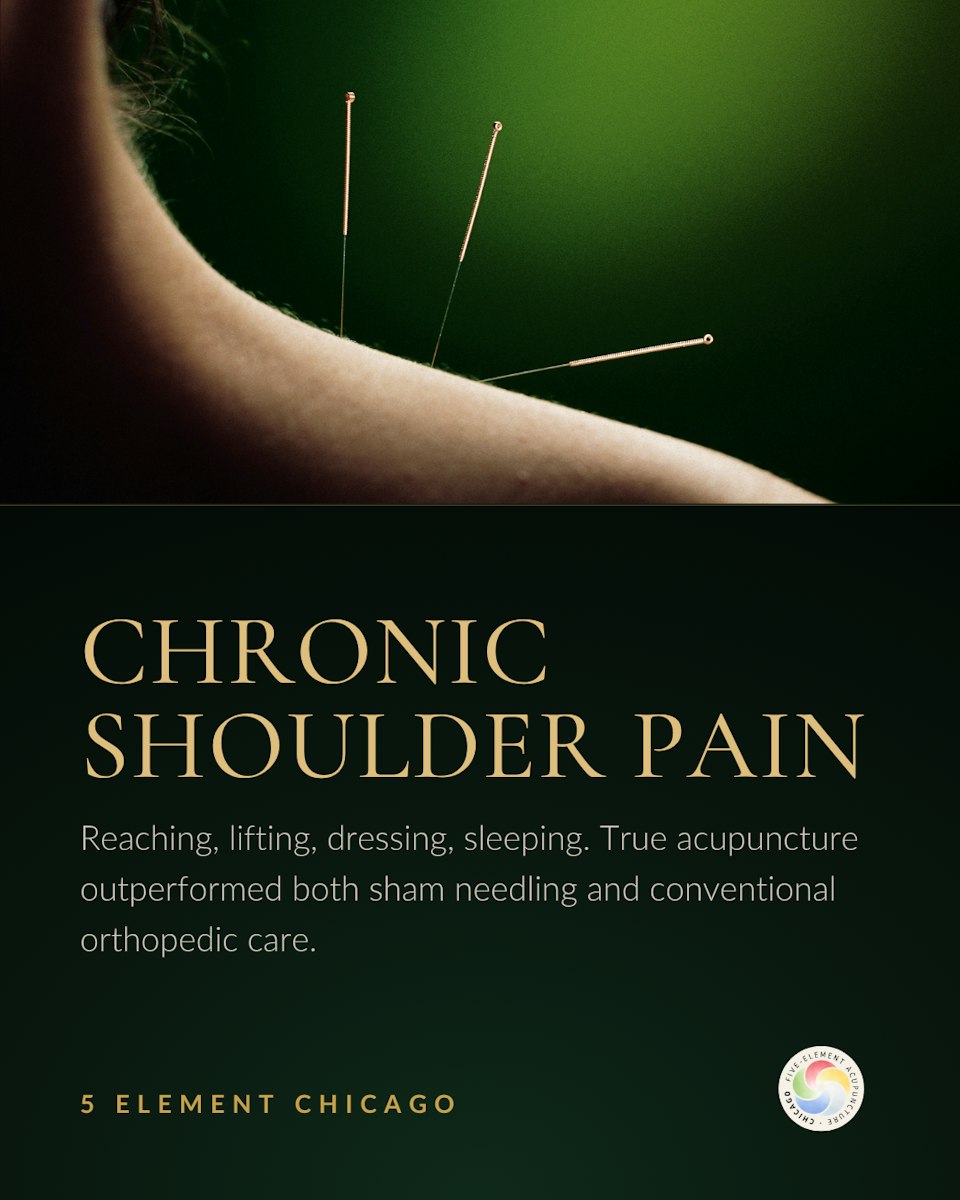
Chronic shoulder pain can make ordinary movements—reaching into a cabinet, getting dressed, lifting a bag, or finding a comfortable sleeping position—feel far more difficult than they should. A randomized clinical trial of 424 people found that a course of traditional Chinese acupuncture was associated with greater pain improvement and better shoulder mobility than either sham acupuncture or conventional orthopedic treatment. For people in Chicago seeking a whole-person approach to persistent pain, this research offers one useful piece of evidence to consider alongside an individualized evaluation.
At 5 Element Chicago, I look beyond the painful area alone. Shoulder discomfort can be shaped by injury history, movement patterns, stress, sleep, overall health, and the way the body is compensating. Acupuncture treatment is not a one-size-fits-all formula; my goal is to understand the person experiencing the pain and support a path toward easier movement and greater resilience.
Why Chronic Shoulder Pain Has Such a Big Impact
The shoulder is involved in an extraordinary number of daily tasks. Even a relatively simple movement, such as reaching overhead or extending an arm behind the body, depends on coordinated motion through the shoulder, upper back, neck, ribs, and surrounding muscles.
When shoulder pain persists, people often begin protecting the area without realizing it. They may avoid certain motions, use the other arm more, tense the neck and upper back, or change how they sleep. Over time, the problem can become about more than a single painful spot: it can affect work, exercise, rest, independence, and quality of life.
That is why pain relief matters, but function matters too. A meaningful treatment plan should consider whether someone can comfortably reach, lift, dress, sleep, and return to the activities that make life feel like their own.
What the GRASP Trial Examined
The German Randomized Acupuncture Trial for Chronic Shoulder Pain, known as GRASP, enrolled 424 outpatients with shoulder pain that had lasted at least six weeks. Participants were randomly assigned to one of three groups: traditional Chinese acupuncture, sham acupuncture, or conventional conservative orthopedic treatment. Each group received 15 treatments over six weeks.
Importantly, the study did not look only at an immediate response. Researchers measured pain outcomes at the end of treatment and again three months later. They also assessed shoulder mobility, including the ability to move the arm away from the body and raise it overhead.
You can review the study abstract on PubMed: German Randomized Acupuncture Trial for Chronic Shoulder Pain (GRASP).
What the Researchers Found
At the three-month follow-up—the study’s primary endpoint—65% of participants in the traditional acupuncture group met the trial’s threshold for meaningful pain response. That compared with 24% in the sham acupuncture group and 37% in the conventional orthopedic-treatment group.
Directly after the treatment course, the pattern was also favorable for traditional acupuncture: 68% of the acupuncture group met the pain-response threshold, compared with 40% of the sham group and 28% of the conventional-treatment group. The differences between traditional acupuncture and both comparison groups were statistically significant.
The researchers also reported greater improvement in shoulder mobility for the traditional acupuncture group, both immediately after treatment and at three months. In practical terms, this is notable because it suggests the changes observed were not limited to a pain score. Participants also showed improvement in movements that can be especially challenging when a shoulder is painful.
Why the Sham Comparison Matters
Acupuncture research can be challenging to interpret, in part because the experience of receiving care—including attention, expectation, and the treatment setting—can influence symptoms. The GRASP trial addressed part of that question by including sham acupuncture and by blinding participants to the type of acupuncture they received.
In this study, traditional Chinese acupuncture performed better than sham acupuncture on the main pain outcome. That does not mean one study answers every question about every kind of shoulder pain or every person. It does mean the trial provides stronger evidence than a simple comparison between acupuncture and no treatment.
What This Does—and Does Not—Mean for You
This trial supports acupuncture as a potential option for chronic shoulder pain, particularly for people who want to address both discomfort and restricted movement. It does not promise that every patient will have the same result, nor does it replace an appropriate medical assessment when needed.
Shoulder pain has many possible contributors, including overuse, tendon irritation, arthritis, bursitis, referred pain from the neck, prior injury, and other conditions. A sudden injury, visible deformity, significant weakness, fever, chest pain, shortness of breath, numbness, or rapidly worsening symptoms deserves prompt medical attention. I encourage patients to seek the right level of medical care for their situation.
For longer-standing symptoms without urgent warning signs, acupuncture may be one part of a thoughtful care plan. Depending on the individual, that may also include changes in activity, restorative movement, physical therapy, sleep support, or coordination with other healthcare professionals.
A Personalized Approach to Shoulder Pain in Chicago
At 5 Element Chicago, I use five-element acupuncture and Chinese medicine to understand the broader pattern behind a patient’s experience. I take time to listen closely—not just to where the pain is located, but to how it began, what aggravates or relieves it, how it affects daily life, and what else may be happening in the body.
When clinically appropriate, I may also incorporate supportive modalities such as cupping, gua sha, or craniosacral therapy. These are never automatic add-ons. They are considered in the context of the individual in front of me and the goals we are working toward together.
For some people seeking pain relief acupuncture in Chicago, the first goal is simply to sleep more comfortably or reach overhead with less apprehension. For others, it is returning to a sport, a workout routine, or a job that demands repetitive movement. My care is designed to meet people where they are and progress at a pace that makes sense for them.
FAQ
How many acupuncture sessions were used in the GRASP trial?
Participants received 15 treatments over six weeks. Individual treatment plans can differ based on the nature and duration of the pain, overall health, response to care, and personal goals.
Can acupuncture improve shoulder movement as well as pain?
In the GRASP trial, the traditional acupuncture group showed greater improvement in measured shoulder mobility than the comparison groups. Results vary by person, but function is an important part of how I evaluate progress.
Is acupuncture appropriate for every type of shoulder pain?
No single treatment is right for every condition. An evaluation can help determine whether acupuncture is a reasonable option and whether you should also be assessed by another healthcare professional.
Should I stop other care if I try acupuncture?
Not necessarily. Acupuncture can often complement other appropriate care. Decisions about medications, physical therapy, imaging, or medical treatment should be made with the relevant qualified healthcare professionals.
When should I seek urgent care for shoulder symptoms?
Seek prompt medical attention for symptoms such as chest pain, shortness of breath, a severe sudden injury, deformity, fever, major weakness, or new numbness. These symptoms may need evaluation beyond acupuncture.
If chronic shoulder pain has been limiting your life and you are looking for an acupuncture Chicago practice that offers time, attention, and individualized care, I welcome the opportunity to talk about whether treatment may be a fit.